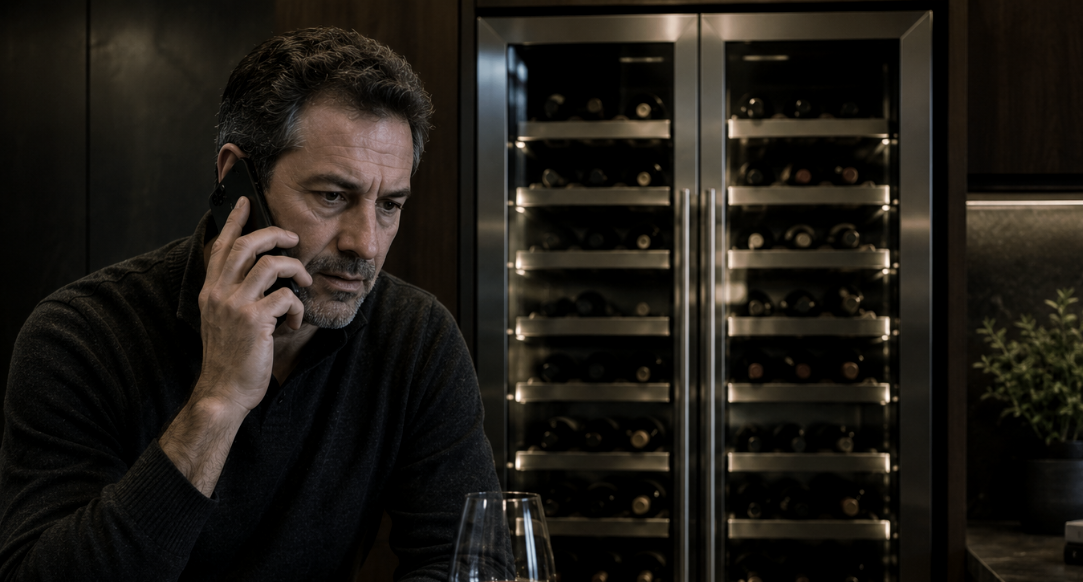
Oversized wine coolers fail differently because high-volume refrigeration systems respond slower under heavy bottle load and extended internal cabinet volume.
The display may still look stable while upper sections warm gradually, recovery slows after openings, or bottle temperatures continue drifting long after the cabinet appears normal again.
We provide professional Oversized Wine Cooler Repair in Miami focused on restoring cabinet-wide consistency, predictable recovery timing, and dependable wine storage performance across large-capacity refrigeration systems.
Why Oversized Wine Coolers Behave Differently
Extended-capacity wine cabinets are not simply larger versions of compact wine coolers.
They operate with heavier thermal mass, taller circulation paths, larger internal air volume, and delayed stabilization behavior that changes how the entire cooling system responds throughout the day.
| Oversized Cabinet Factor | Why It Matters |
|---|---|
| Heavy bottle load | Slower thermal stabilization |
| Tall cabinet height | Harder vertical circulation balancing |
| Large internal volume | Delayed cooling response |
| Extended recovery cycles | Slower pull-down after openings |
| Long airflow paths | Uneven shelf temperatures appear easier |
| Large glass-door exposure | More ambient heat enters the cabinet |
| Dense bottle arrangement | Circulation channels become restricted |
In high-volume wine refrigeration systems, the issue is often not whether cooling exists.
The issue is whether the entire cabinet can stabilize evenly under real storage conditions.
Oversized Wine Cabinets & High-Capacity Systems We Service
We service many extended-capacity wine refrigeration systems commonly installed in Miami luxury homes, hospitality spaces, wine rooms, and designer interiors.
Service includes:
- oversized wine coolers
- large wine cabinets
- tall wine refrigerators
- high-capacity wine coolers
- 100+ bottle wine cabinets
- multi-section wine refrigeration
- large freestanding wine coolers
- luxury wine storage systems
- floor-standing wine cabinets
- glass-door wine display cabinets
- collector wine refrigeration systems
- full-height wine refrigerators
High-volume wine cabinets often hide instability longer because heavy bottle mass slows visible temperature change throughout the storage area.
Wine Cooler Brands We Repair
We work with many oversized and luxury wine refrigeration brands commonly used in Miami residential and hospitality environments.
Large Wine Cabinet & Luxury Residential Systems
Liebherr • EuroCave • Miele • Thermador • Viking • JennAir • Gaggenau • Vinotemp • U-Line • Marvel • True Residential • Bosch • KitchenAid • Perlick• Fisher & Paykel
High-Capacity Freestanding Wine Refrigeration
Avallon • EdgeStar • Lanbo • Kalamera • Wine Enthusiast • NewAir • Allavino • Cuisinart where applicable
Commercial & Hospitality Wine Storage
True • Beverage-Air • Hoshizaki • Perlick • Turbo Air • Traulsen
High-capacity wine systems often reveal failure through delayed recovery and cabinet-wide inconsistency rather than immediate cooling loss.
What Homeowners Usually Notice First
Oversized wine cooler problems usually begin as gradual instability across the cabinet rather than obvious shutdown.
| What You Notice | What It Usually Means | Priority |
|---|---|---|
| Upper shelves feel warmer | Vertical circulation imbalance | High |
| Cabinet takes hours to stabilize | Heavy thermal-mass recovery delay | High |
| Bottles feel warmer than the display suggests | Sensor-to-bottle mismatch | High |
| One side of the cabinet cools differently | Large-volume circulation imbalance | Medium |
| Cooling slows after loading bottles | Recovery overload under thermal mass | Medium |
| High-capacity cabinet runs constantly | Compressor stress under heavy storage load | High |
| Bottom shelves stay colder than upper storage | Vertical temperature drift | Medium |
| Cabinet appears stable but wine feels inconsistent | Delayed cabinet-wide stabilization | High |
Most large-capacity wine systems continue operating while storage consistency slowly becomes less reliable.
Why Miami Conditions Matter for Oversized Wine Cabinets
Oversized wine refrigeration systems are heavily affected by Miami environmental conditions because large cabinet volume reacts slower to ambient heat and humidity changes.
That becomes especially noticeable in:
- open luxury kitchens
- waterfront homes
- glass-heavy interiors
- hospitality environments
- wine display spaces
- rooms with afternoon sun exposure
Miami conditions commonly increase:
- thermal recovery time
- vertical temperature drift
- cabinet heat retention
- glass-door condensation
- compressor runtime
- delayed stabilization cycles
- humidity imbalance
- bottle-temperature lag
Large wine cabinets may appear stable early in the day, then slowly drift as thermal accumulation builds throughout the cabinet volume.
Real Oversized Wine Cooler Problems We Repair
In oversized systems, these issues are driven more by thermal mass and delayed response than cabinet structure alone.
Upper Shelves Warmer Than Lower Storage
Tall wine cabinets often develop vertical temperature imbalance before obvious cooling failure appears.
Warm air naturally rises, while extended circulation paths become harder to stabilize evenly across the full cabinet height.
Common causes include:
- weak circulation airflow
- upper-section airflow restriction
- overloaded shelving
- evaporator-side imbalance
- fan fatigue
- delayed vertical cooling response
The issue is not whether one area still feels cold.
The issue is whether the entire cabinet remains stable from top to bottom.
Oversized Wine Cabinet Takes Too Long to Recover
High-volume wine systems recover differently because heavy bottle mass absorbs and releases heat slowly.
After openings or bottle loading, the display may stabilize faster than the actual wine inside the cabinet.
Common causes include:
- overloaded recovery demand
- declining compressor efficiency
- weak circulation movement
- dense bottle arrangement
- condenser heat buildup
- restricted airflow channels
A healthy oversized cabinet should stabilize predictably instead of remaining trapped in extended recovery cycles.
Display Looks Correct but Bottles Feel Warm
This is one of the most misleading large wine cabinet problems.
The sensor may react to surrounding air while the actual bottle temperature remains unstable for hours afterward.
Common causes include:
- sensor placement imbalance
- delayed thermal response
- unstable recovery timing
- vertical circulation inconsistency
- calibration drift
- internal airflow separation
In oversized systems, bottle temperature matters more than short-term display readings.
High-Capacity Wine Cooler Runs Constantly
Extended-capacity wine cabinets naturally operate longer than compact systems, but nonstop runtime usually signals inefficient thermal recovery.
Common causes include:
- excessive cabinet heat load
- compressor fatigue
- weak condenser airflow
- large glass-door heat exposure
- overloaded storage density
- unstable stabilization cycles
The problem is not simply runtime.
The problem is whether the cabinet can still maintain reliable storage conditions efficiently across the full bottle load.
Uneven Cooling Between Cabinet Sections
Large wine refrigeration systems often develop cooling inconsistency across separate cabinet areas long before total cooling failure occurs.
Common causes include:
- circulation imbalance
- blocked rear airflow
- uneven bottle density
- evaporator airflow restriction
- weak fan operation
- temperature stratification
High-volume wine cabinets require cabinet-wide stabilization — not isolated cold sections.
Glass Condensation on Large Wine Cabinets
Large glass-door wine cabinets are more vulnerable to visible condensation because increased surface area reacts more aggressively to humidity and delayed recovery behavior.
Common causes include:
- unstable humidity control
- warm-air intrusion
- delayed stabilization cycles
- glass thermal imbalance
- prolonged door openings
- circulation inconsistency
The important question is why the cabinet can no longer stabilize moisture across such a large storage environment.
Large Wine Cabinet Stable at Night but Drifting During the Day
Oversized wine coolers often appear normal overnight because thermal demand temporarily decreases.
As ambient heat and cabinet activity increase throughout the day, storage consistency begins drifting gradually.
Common causes include:
- compressor weakening under daytime thermal load
- heavy thermal inertia
- circulation fatigue
- condenser overheating
- delayed recovery under ambient heat
This is a classic large-volume refrigeration pattern where instability appears progressively rather than suddenly.
What “Fixed” Should Mean for Oversized Wine Coolers
An oversized wine cabinet should not simply restart and temporarily feel cooler again.
After proper repair, the system should maintain believable storage consistency across the entire cabinet volume under real daily use conditions.
| Verified Result | What It Actually Means |
|---|---|
| Upper and lower shelves remain closer in temperature | Vertical circulation stabilized |
| Recovery improves after openings | Thermal load handled correctly |
| Bottle temperatures feel believable | Real storage conditions restored |
| Runtime becomes more controlled | Cooling efficiency improved |
| Cabinet stabilizes faster | Recovery behavior functioning properly |
| Glass condensation stops returning | Humidity response normalized |
| Large bottle loads recover more evenly | Circulation restored across the cabinet |
| Cooling remains consistent throughout the day | High-volume system performs reliably |
That is a stronger standard than simply saying the cabinet powers back on.
Why Homeowners Choose Us for Oversized Wine Cooler Repair in Miami
Oversized wine refrigeration systems require a very different diagnostic approach than compact residential coolers.
Large-capacity cabinets must be evaluated for:
- vertical cooling consistency
- thermal recovery timing
- cabinet-wide circulation behavior
- bottle-load stabilization
- high-volume heat retention
- delayed sensor response
- recovery performance under real storage conditions
That means:
- real temperature verification across cabinet sections
- circulation evaluation throughout tall storage areas
- recovery-cycle analysis
- careful handling around large wine collections
- performance confirmation before completion
- experience with oversized luxury wine refrigeration systems
Large wine storage should feel stable across the full cabinet — not colder in one section and unreliable in another.
FAQ — Oversized Wine Cooler Repair in Miami, FL
Q: Why are the upper shelves warmer in my tall wine cabinet?
A: Large cabinets often develop vertical circulation imbalance where upper storage sections recover slower than lower areas.
Q: Why does my oversized wine cooler take so long to stabilize?
A: Heavy bottle mass and extended cabinet volume naturally slow recovery, but excessive delay usually points to cooling inefficiency or circulation imbalance.
Q: Why do the bottles feel warmer than the display shows?
A: Large wine cabinets may stabilize surrounding air faster than the actual bottle temperature inside the cabinet.
Q: Is nonstop runtime normal in high-capacity wine cabinets?
A: Longer cycles are common, but nonstop operation usually indicates thermal stress or inefficient recovery behavior.
Q: Why does my wine cabinet seem stable overnight but warmer during the day?
A: Ambient heat and daytime thermal accumulation often expose recovery weakness in large-capacity refrigeration systems.
Q: Can overloaded shelves affect cooling performance?
A: Yes. Dense bottle storage may restrict circulation and slow cabinet-wide stabilization.
Q: Are oversized wine cabinet repairs usually worth it?
A: Often yes, especially for premium high-volume systems where replacement and installation costs are significant.
Q: Why is condensation appearing on the glass door?
A: Large glass-door cabinets are more sensitive to humidity imbalance and delayed thermal recovery behavior.
Miami Areas We Serve
We provide oversized wine cooler repair throughout Miami and surrounding luxury residential and hospitality areas.