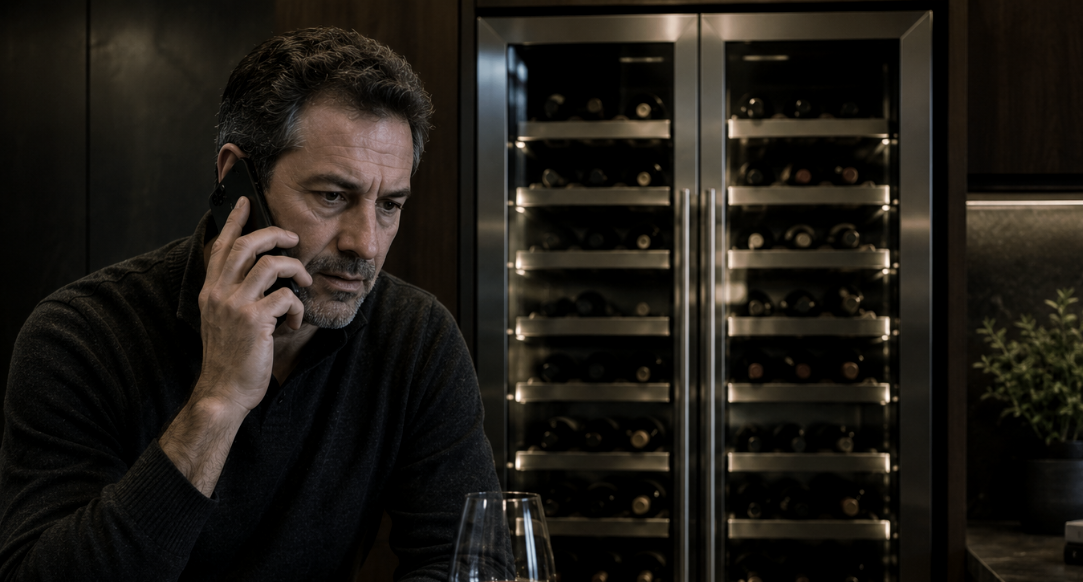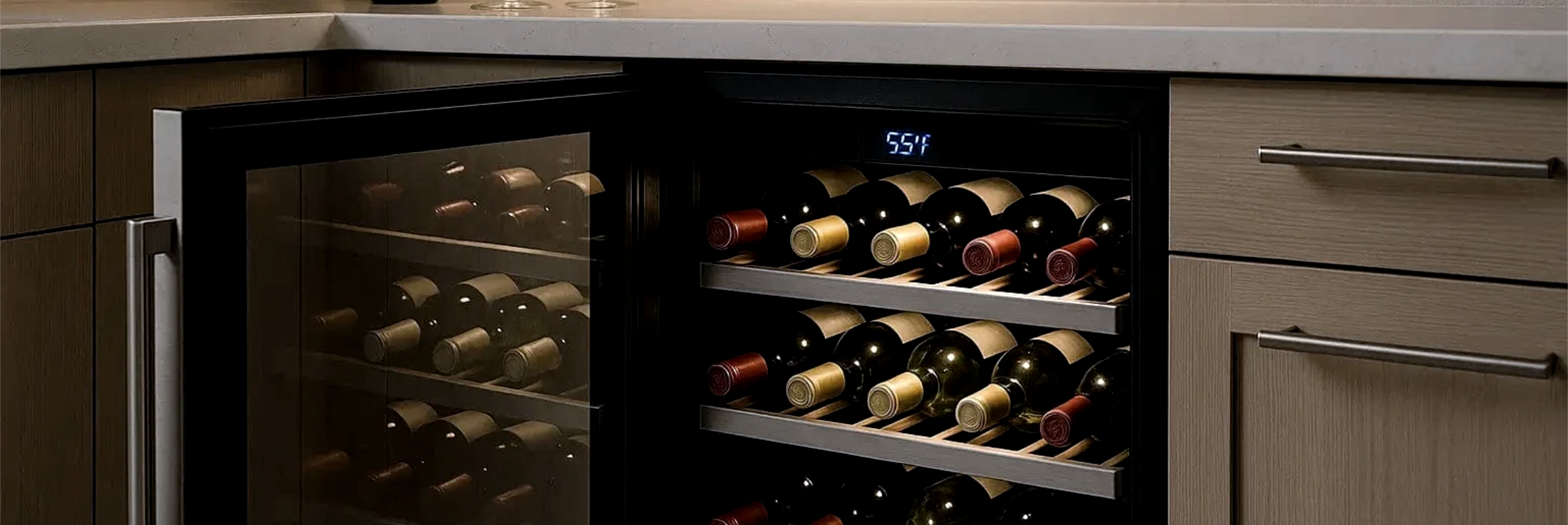
Frost on the back wall, ice creeping over a rack — inside an appliance that was never meant to freeze anything.
Ice in a wine fridge is always a symptom, never a setting. Here’s what builds it and how to clear it without wrecking the coil.
Ice spreading fast? Call 786-377-9387 or book a same-day visit.
First, make sure this is your problem
- Ice AND warm bottles → start with why a wine cooler stops cooling.
- Only one zone frosting or warm → see dual-zone: one zone warm.
- Droplets and mist, no actual ice → that’s condensation, normal or not.
- Real frost or ice while it still cools → you’re in the right place.
Quick diagnosis: where the ice is → what’s behind it
| Where you see it | Most likely cause | Priority |
|---|---|---|
| Thin frost film on the back wall | Humid air freezing on the coldest surface — check the seal | Medium |
| Thick ice slab on the back wall | Defrost fault or a long-standing seal leak | High |
| Frost ring near the door | Gasket leaking at that edge | Medium |
| Ice on bottles near the rear | Overcooling — bottles touching the cold plate | Medium |
| Ice returns days after defrosting | Sensor or defrost circuit failure | High |
| Ice plus water on the floor | Melt cycles overwhelming a blocked drain | High |
Why does ice form in a fridge that isn’t a freezer?
- Humid air met a cold plate. Every cubic foot of entering air drops its moisture on the coldest surface — steady inflow becomes steady frost.
- The seal is the usual gate. A leaking gasket feeds that inflow around the clock — test the door seal before blaming electronics.
- The defrost cycle quit. Compressor units melt their own frost between cycles; when that sensor or heater fails, frost compounds into a slab.
- Overcooling near the dew point. A setpoint pushed too low drives the back wall below freezing — chasing 45°F in a humid room manufactures ice.
- Bottles against the cold plate. Glass touching the rear wall super-chills and frosts first — the rack pattern keeps a gap for a reason.
The right way to defrost
- Unplug and empty it. Move the bottles somewhere cool and dark — the defrost takes a full day done right.
- Door open, towels down, 24 hours. Room air does the work safely; patience is the entire technique.
- Never chip, never pry. The coil and liner behind the ice cost more than any repair this article prevents.
- Skip the hair dryer. Concentrated heat warps liners and stresses the coil — if you must speed it up, a fan blowing room air is the ceiling.
- Clear the drain while it melts. A cotton swab in the drain hole and a cup of water after — meltwater needs somewhere to go.
- Restart and watch a week. Clean start, thermometer inside, gasket tested — what happens next is the diagnosis.
No time for a 24-hour melt? Call 786-377-9387 or book a diagnostic online.
If the ice comes back
- Back within days — the defrost sensor or circuit has failed; the ice is faster than any seal leak could build it.
- Back within weeks, near the door — the gasket is the gate; fix the seal, not the symptom.
- Back only in summer — humidity load has outrun the unit’s margins; placement and seal together decide it.
- Back behind a busy bar — hundreds of door cycles a night out-humidify any defrost schedule; glass-door boxes like Hoshizaki and Turbo Air merchandisers live on quarterly coil-and-drain service for exactly this.
The Miami factor
- More humidity, faster frost. The same seal gap frosts a wall across Miami in a week that would take a month inland.
- Party traffic compounds it. Entertaining season in Miami Beach means door cycles that feed the frost between every pour.
- Outage-melt-refreeze cycles. Storm blinks half-melt the frost and refreeze it into harder ice — each cycle worse than the last.
- Meltwater finds the floor. A defrost dump plus a mold-plugged drain is how ice stories end as flooring stories here.
When to stop DIY and call a technician
The defrost and the seal test are yours; recurring ice is professional wine cooler repair:
- Ice returns after a full defrost and a passing seal test — sensor and defrost-circuit faults are meter diagnoses.
- A dual-zone ices one zone only — that’s the damper path freezing; forcing it snaps the actuator.
- The slab hid liner damage — cracks and lifted panels under old ice need sealing before the next cycle grows in them.
- Ice and warm bottles arrive together — the evaporator is choking; every day of running builds the slab thicker.
Zone icing and defrost faults are daily scope for single and dual zone wine cooler repair.
Third defrost this month? Call 786-377-9387 or book the repair.
Keep the ice from coming back
- Bill-test the gasket each season — the seal is the gate for every frost story.
- Don’t chase cold setpoints — 55°F stores wine; 45°F in a humid room manufactures ice.
- Keep bottles off the back wall — the rack gap is frost prevention, not wasted space.
- Flush the drain quarterly — meltwater with nowhere to go becomes the next layer of ice.
- Reset properly after outages — a scrambled control skipping defrost cycles builds slabs silently.
FAQ: frost inside a wine fridge
Q: Why is there frost on the back wall of my wine fridge?
A: Humid air is entering — usually through a tired door seal — and freezing on the coldest surface. A thin film says seal; a thick slab says the defrost cycle has failed too.
Q: How do I defrost a wine fridge safely?
A: Unplug, empty, door open, towels down, 24 hours of room air. Never chip the ice and never aim a hair dryer at the coil.
Q: Why does ice keep coming back after I defrost?
A: Days = defrost sensor or circuit; weeks near the door = gasket; summers only = humidity outrunning the unit. The return speed is the diagnosis.
Q: Can frost damage the wine?
A: Not directly — but the airflow it chokes swings the cabinet temperature, and bottles frozen to the back wall can super-chill. The slab is a system problem wearing a white coat.
Q: Should a wine fridge ever have ice in it?
A: No — wine fridges run above freezing by design. Any ice at all means moisture is entering faster than the system sheds it.