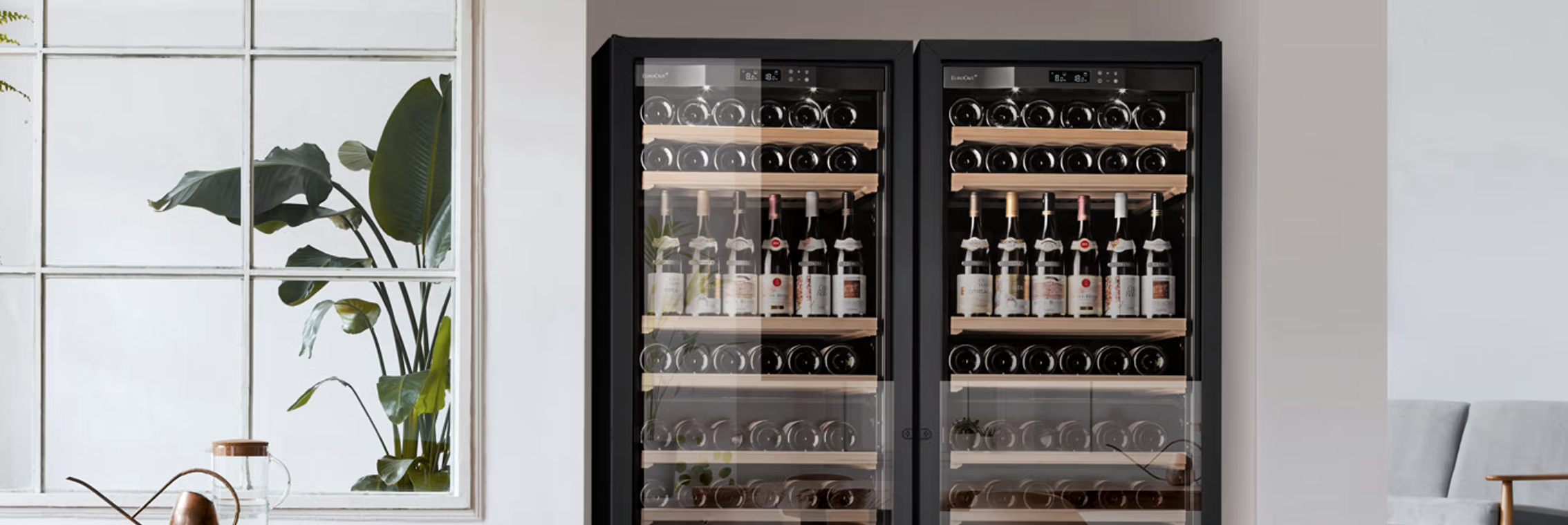
It fits the space perfectly. It matches the cabinets. And within a season, the freestanding wine cooler you slid into that opening starts running hot, loud, and warm.
The short answer to the title: no — and the reason kills more wine coolers in nice kitchens than any factory defect.
Unit already boxed in and struggling? Call 786-377-9387 or book a same-day visit.
First, make sure this is your problem
- Your built-in runs nonstop → see runs constantly and never shuts off.
- It runs but stalls short of temperature → see running but not cold enough.
- You’re planning an install — or wondering why yours failed after one → you’re in the right place.
Freestanding vs built-in: the difference that decides everything
| Trait | Freestanding | Built-in (front-vented) |
|---|---|---|
| Where heat exits | Back and sides | Front grille |
| Clearance needed | Several inches behind and beside | Essentially flush |
| In a cabinet opening | Overheats — vents blocked | Designed for exactly this |
| Under a counter | Same problem, slower | Fine by design |
| Price for the same capacity | Lower | Higher — you pay for the venting design |
What actually happens to a boxed-in freestander?
- The exhaust has nowhere to go. Heat leaves through the back — into a closed pocket that feeds it straight back in.
- The pocket becomes an oven. Every cycle raises the air the condenser must breathe; efficiency falls as the pocket warms.
- The compressor compensates — for a while. Longer runs, louder hum, warmer cabinet sides: the sound of margin being spent.
- Then the failures start. Overheat trips, cooked relays, early compressor wear — the classic “it worked fine for a year” story.
- And the wine pays meanwhile. The unit that can’t shed heat can’t hold 55°F on hot afternoons — bottles ride the swings.
How do you know it’s the install, not the unit?
- Feel the surround. Warm cabinetry beside or above the cooler means exhaust is soaking into the pocket.
- Compare morning to afternoon. An install problem tracks the day’s heat; a parts problem doesn’t care what time it is.
- Pull it out for a week. The definitive test: freestanding in open air, same settings — if it holds temperature, the opening was the fault.
- Check the spec sheet. The manual states the required clearances; measure what the opening actually gives it.
Test says “install” and you want it fixed right? Call 786-377-9387 or book an assessment.
What are the real options for cabinet installs?
- A true built-in unit. Front-vented columns — Thermador wine columns and Fisher & Paykel integrated models are the archetypes — breathe through the toe-kick and live happily flush.
- Re-engineer the opening. Rear void, top gap, and vent cutouts can sometimes give a freestander legal air — cabinetry work, but cheaper than early replacement cycles.
- Relocate the freestander. Give it open air and put the built-in budget where the cabinet is — often the cleanest math.
- What never works: hoping. A freestander “mostly fitting” is a countdown, not a solution — the physics doesn’t negotiate.
The Miami factor
- Warm kitchens shrink the margin. The boxed-in freestander that limps along up north fails outright in a Doral summer kitchen.
- Renovation season creates the patients. Kitchen remodels across Miami produce beautiful openings sized for looks, not airflow.
- Condo cabinetry runs tight. Space-optimized high-rise kitchens leave even less accidental clearance than houses do.
- Humidity joins the party. A hot pocket is also a damp pocket — condensation and swollen panels arrive with the heat.
When to stop DIY and call a technician
The pull-out test and the spec check are yours; the rest is professional wine cooler repair:
- The unit overheated for months — relays, boards, and the compressor need checking before the damage compounds.
- The opening needs engineering judgment — what clearance this model truly needs, and whether this cabinet can give it.
- A built-in column misbehaves flush — front-vented units have their own failure modes, all core built-in wine cooler repair scope.
- The compressor already runs too hot to touch — overheat damage is cumulative, and a check now costs far less than the part it saves.
Install verdict plus repair in one visit: call 786-377-9387 or book online.
Install it right the first time
- Match the unit to the opening before buying — “built-in capable” on the spec sheet is the phrase that matters.
- Give even built-ins their toe-kick — rugs, pet beds, and new trim over the front grille undo the whole design.
- Re-check after every renovation — the most common ventilation kill is a carpenter who never knew the grille existed.
- Feel the surround seasonally — warm cabinetry is the earliest, cheapest warning the airflow gives.
FAQ: freestanding wine cooler in a cabinet
Q: Can you put a freestanding wine cooler in a cabinet?
A: No — freestanding units vent through the back and sides, and a cabinet blocks exactly that. They overheat, run constantly, and fail early. Cabinet openings need front-vented built-in models.
Q: What happens if I do it anyway?
A: It usually works for a while — then longer runtimes, heat-soaked cabinetry, temperature swings, and an early compressor death. The failure is built into the airflow, not the luck.
Q: How much clearance does a freestanding wine fridge need?
A: Follow your model’s manual — typical guidance runs several inches behind and beside the unit, with free air above. If the opening can’t give that, it needs a built-in model instead.
Q: What’s the difference between freestanding and built-in wine coolers?
A: Where the heat exits: back-and-sides versus front grille. That single trait decides where each can live — and why built-ins cost more for the same bottle count.
Q: Why is my built-in wine cooler failing even though it’s front-vented?
A: Usually because the front grille lost its air — blocked toe-kick, dust mat, or trim added later. The design works only while the grille breathes.