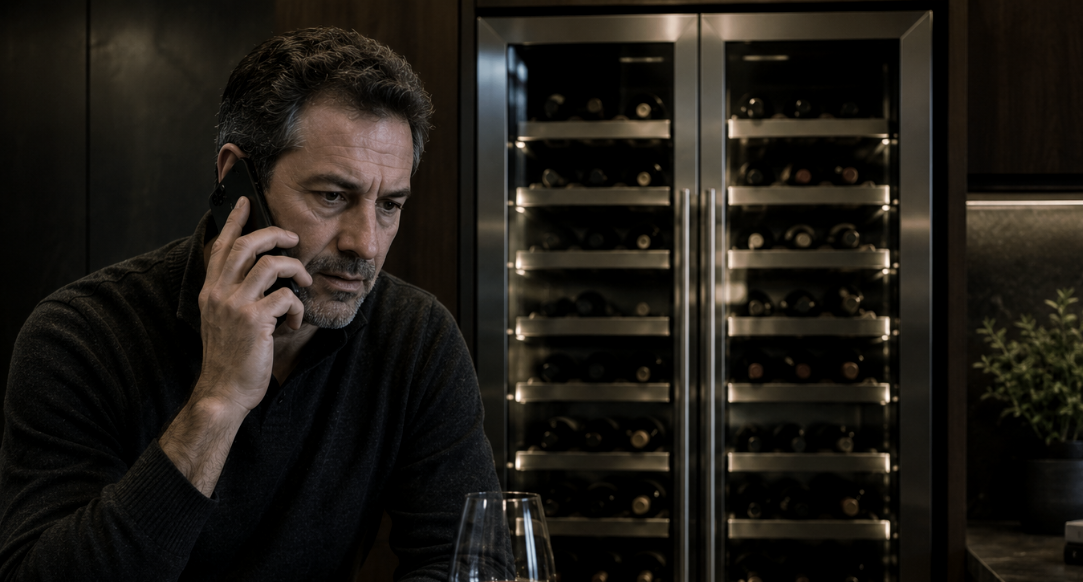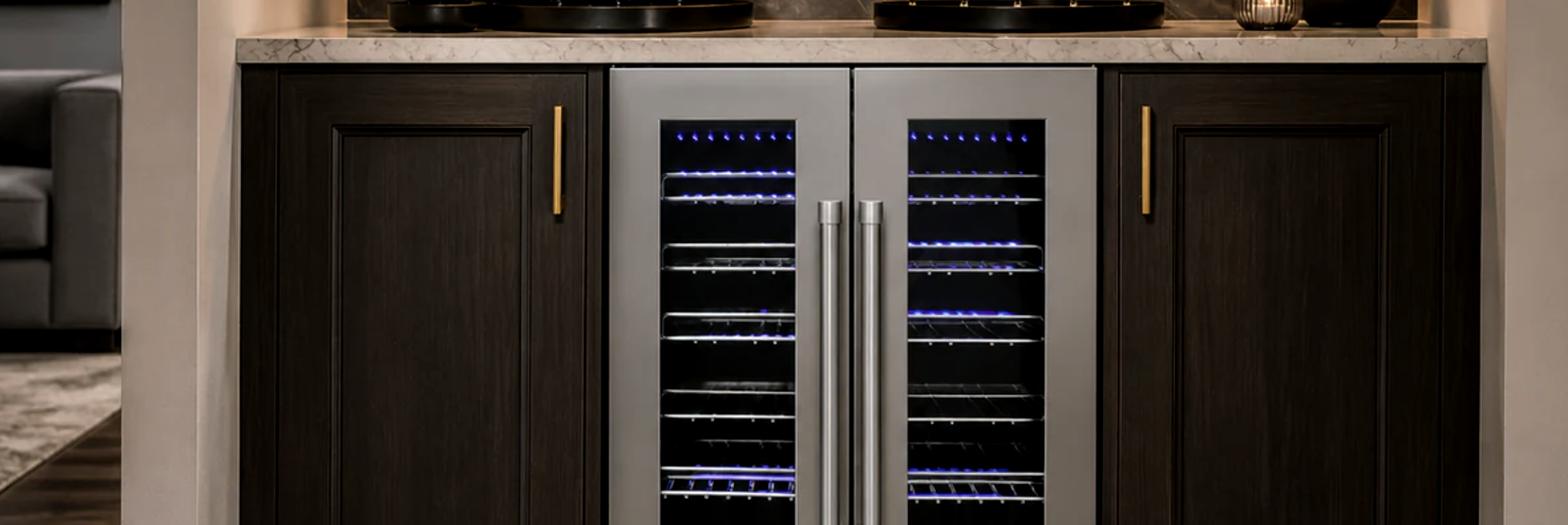
The wine cooler holds its temperature — but the compressor never takes a break. Day and night, the hum just doesn’t stop.
A cooler should cycle on and off. One that runs constantly is paying for something, and the bill arrives as electricity now and parts later.
Compressor on a marathon? Call 786-377-9387 or book a same-day visit.
First, make sure this is your problem
- Runs nonstop AND can’t reach temperature → see running but not cold enough.
- Clicks and stops instead of running → that’s compressor hot or clicking.
- Holds temperature fine, just never shuts off → you’re in the right place.
Quick diagnosis: running pattern → what it means
| Pattern | What it means | Priority |
|---|---|---|
| Runs 100%, holds temperature | Losing cold somewhere — seal, coils, or placement | Medium |
| Runs 100% only on hot afternoons | Normal near the ambient ceiling | None |
| Runs more than last summer, same room | Capacity eroding — coils or refrigerant | Medium |
| Never cycles even at night | Sensor stuck or airflow starved | High |
| Thermoelectric unit, near-constant run | Normal — Peltier systems barely cycle by design | None |
| Runs 100% and louder than before | Straining — clean the coils today | Medium |
How much running is actually normal?
- A healthy compressor unit cycles — roughly a third to half of each hour in a mild room, more in heat.
- Hot afternoons can mean 100% duty — as long as it cycles again at night, that’s the ambient ceiling, not a fault.
- A new or just-loaded unit runs a full day — pulldown of warm bottles is real work; judge after 24 hours.
- Thermoelectric units run almost constantly by design — Peltier cooling doesn’t cycle like a compressor; that’s normal for the type.
- The red flag is change — the same unit, the same room, and suddenly no pauses: something started leaking cold.
Find the cold leak: checks in order
- Vacuum the coils. Dirty coils are the number-one reason compressors work overtime — everywhere, every brand.
- Clear the front grille. Built-in columns breathe only through it — on Thermador and JennAir columns alike, a blocked toe-kick means a compressor that never rests.
- Run the dollar-bill test on the gasket. A leaking seal feeds warm air in around the clock — the compressor is matching that leak hour for hour.
- Check what’s next to it. Ovens, dishwashers, sunny windows, or underfloor heating below — heat sources beside the cabinet rewrite its duty cycle.
- Look at the load. A cabinet stuffed past its rack pattern blocks internal airflow, and the sensor chases air it can’t reach.
- Compare display to a thermometer. A sensor stuck reading warm keeps calling for cold forever — the classic invisible cause.
Checks done, still no pauses? Call 786-377-9387 or book a diagnostic online.
What nonstop running costs you
- Electricity, first and visibly — a cooler at 100% duty can double its share of the bill.
- Compressor life, quietly — running hours are the currency compressors are rated in; constant duty spends them double-speed.
- Humidity balance — endless cooling over-dries the cabinet air and pulls the 50–70% band down toward cork territory.
- Your early-warning system — a unit already at 100% has no reserve left for the first heat wave; it fails on the worst day.
The Miami factor
- Summer rewrites “normal” here. Duty cycles across Miami run long June through October — the test is whether night brings pauses back.
- Kitchens amplify it. A built-in flanked by a range in a Coral Gables kitchen fights the house’s hottest wall.
- Salt-dulled condensers can’t rest. A corroded coil sheds less heat per minute, so the compressor buys the difference in minutes.
- A/C setbacks backfire. Raising the house thermostat while away hands the cooler a hotter room and a longer shift — quietly, for weeks.
When to stop DIY and call a technician
Coils, seals, and placement are yours; past that starts professional wine cooler repair:
- No pauses after clean coils, clear vents, tight seal — remaining suspects are the sensor and the refrigerant charge; both are meter work.
- Duty has grown month over month — that trend line is a slow leak’s signature, and gauges read it in minutes.
- The display disagrees with a thermometer — a stuck thermistor keeps the compressor enslaved; replacement is quick with the right part.
- A built-in needs its cavity assessed — heat-pocket installs are measured with probes, then fixed once, correctly.
Ventilation-driven marathons are the daily bread of built-in wine cooler repair.
Still humming around the clock? Call 786-377-9387 or book the visit.
Give the compressor its breaks back
- Coils twice a year — the single cheapest hour of compressor life you can buy.
- Grille check after any kitchen change — most starved built-ins date from a renovation.
- Gasket wipe and bill-test each season — seals fail gradually, then suddenly.
- Mind the neighbors — every appliance and sunbeam beside the cabinet is on its payroll.
- Listen for the pauses — the day they disappear is the day to act, months before the failure.
FAQ: wine cooler runs constantly
Q: Is it normal for a wine cooler to run all the time?
A: Compressor units should cycle on and off; constant running means something is stealing cold. The exception is thermoelectric units, which run near-constantly by design.
Q: Why does my wine fridge never shut off?
A: Dirty coils, a blocked grille, a leaking door seal, nearby heat, or a stuck sensor — in that order of likelihood. The free checks find most of it.
Q: Does constant running damage the compressor?
A: It spends the compressor’s rated hours at double speed and leaves no reserve for heat waves. The unit fails earlier, and usually on the hottest day.
Q: Why does it run constantly only in summer?
A: Ambient heat near the unit’s rating forces long duty — normal if night restores cycling. If pauses never return, capacity has been lost.
Q: How much electricity does a constantly running wine fridge use?
A: Roughly double its normal share — a unit designed to sip at a third duty is now drinking at full. The kWh line item is often the first clue owners notice.