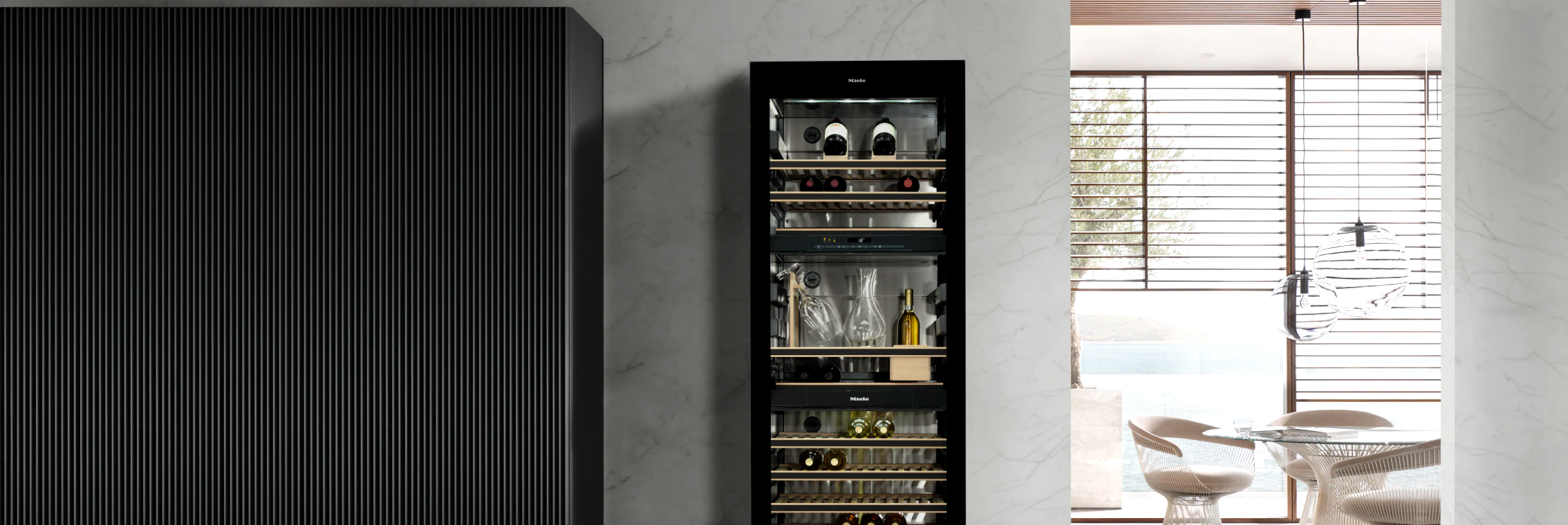
A puddle under the wine fridge, or water pooling on the inside floor under the bottom rack. Either way — the water is telling you where to look.
Most leaks are a blocked drain, and that’s a ten-minute fix. Here’s how to tell that case apart from the ones that need a technician.
Water near a wood floor? Call 786-377-9387 or book a same-day visit before the finish pays for it.
First, make sure this is your problem
- Mist or droplets on the glass door, no standing water → that’s condensation, normal or not — a different question.
- Unit also stopped cooling → the leak is a side effect; start with why a wine cooler stops cooling.
- Actual water — inside floor or under the cabinet → keep reading.
Quick diagnosis: where’s the water → likely cause
| Where you find water | Most likely cause | Priority |
|---|---|---|
| Inside floor, under the bottom rack | Clogged drain hole or drain tube | Medium |
| Under the unit, at the back | Cracked or overflowing drip pan | Medium |
| Runs out the front when door opens | Drain blocked, water backing up | Medium |
| Around the door frame | Worn gasket — humid air condensing heavily | Medium |
| Sudden large puddle, unit off | Defrost meltwater with nowhere to drain | High |
| Water + unit not cooling | Iced evaporator melting through failures | High |
Where the water is supposed to go
Every compressor wine fridge makes water on purpose: humidity condenses on the cold evaporator, runs down to a drain hole, through a tube, into a pan by the compressor — and evaporates there from the compressor’s own heat.
A leak means one link in that chain broke. Almost always it’s the smallest one: the drain hole.
Unclog the drain: ten minutes, no tools
- Unplug the unit and take out the bottom rack — the drain hole sits at the lowest point of the back wall inside.
- Clear the hole. A cotton swab or pipe cleaner pulls out the usual plug of dust, label glue, and mold.
- Prove it flows. Pour a small cup of water into the hole — it should disappear steadily. If it backs up, the tube behind is still blocked; a flexible brush reaches it.
- Check the drip pan. Slide it out (bottom rear), empty it, look for cracks and mold. A cracked pan drips onto the floor no matter how clean the drain is.
Drain clear but water keeps coming? Call 786-377-9387 or book a diagnostic online.
If it’s not the drain
- Worn door gasket. Humid air pouring in condenses faster than the drain can carry away — the fix is the seal, not the drain. Common on kitchen units that get opened all evening — and on freestanding cabinets like KitchenAid’s full-height cellars, where the gasket is a stocked replacement part.
- Tilted installation. A unit leaning forward sends meltwater over the door lip instead of to the rear drain. Check with a level — leveling feet fix it.
- Defrost system failure. Ice builds on the evaporator, then dumps water in bulk when it finally melts. Any brand can develop it; on under-counter units — Bosch among them — it typically shows as repeat puddles every few weeks, a sensor-level fault rather than a drain problem.
- Overloading creates cold pockets. Bottles pressed against the back wall chill below the dew point and sweat where the drain can’t catch it — the puddle lands under the rack, not at the drain hole.
- A door left ajar overnight. One night of open-door humidity dumps a week’s worth of condensate in one go — check the hinges and the self-close before blaming the machine.
The Miami factor
- More humidity, more condensate. A unit that produces a cup a week up north can produce a gallon anywhere in Miami — small drain blockages flood instead of smolder.
- Wood floors raise the stakes. In Coconut Grove homes the leak is often discovered by the floor finish, not the fridge — check the drip pan seasonally, not annually.
- AC outages spike condensate. When the house AC fails or gets set back, indoor humidity jumps and the cooler suddenly produces double the water — right when nobody is watching the pan.
- Drains never dry out here. Year-round humidity keeps the drain tube wet twelve months a year, so the mold plugs that take two seasons up north grow in one summer in Miami.
When to stop DIY and call a technician
If the checklist didn’t end the leak, it’s wine cooler repair territory:
- Water returns within days of a clean, flowing drain — the unit is producing abnormal condensate, and the source (gasket, defrost, airflow) needs tracing before it warps the cabinet floor.
- The leak pairs with warm bottles or ice on the back wall — water plus warmth is a defrost or sealed-system fault wearing a plumbing disguise, and it only compounds.
- The drip pan is cracked or the tube is disintegrating — universal pans rarely sit right over the compressor’s heat, so a near-fit replacement just relocates the puddle.
- Water appears in a different spot each time — meltwater is tracking along the liner and dropping wherever it finds an edge; the source needs proper tracing, not another towel.
Repeat leaks are usually a defrost or airflow fault wearing a water disguise — finding which one is freestanding wine cabinet repair work.
Water keeps coming back? Call 786-377-9387 or book a leak diagnostic.
Keep the water where it belongs
- Pour a cup of water down the drain hole each season — thirty seconds that proves the entire condensate path still works.
- Check the drip pan whenever you vacuum the coils — a crack found in the pan costs nothing; a crack found on the floor costs a floor.
- Wipe the gasket monthly — a clean, tight seal admits less humid air, so the unit makes less water to begin with.
- Re-level the unit after any move or new flooring — a forward lean sends meltwater over the door lip instead of to the rear drain.
- Wipe interior spills promptly — sugared drips are exactly how drain holes grow their plugs.
FAQ: wine fridge leaking water
Q: Why is there water in the bottom of my wine fridge?
A: The condensate drain hole at the back is blocked, so normal defrost water pools instead of draining. Clearing it with a cotton swab fixes most cases.
Q: Why is my wine cooler leaking water on the floor?
A: Usually the drip pan — cracked, moldy, or overflowing because the unit suddenly produces more condensate than it evaporates. Check the pan before blaming the plumbing.
Q: How do I unclog the drain hole in a wine fridge?
A: Unplug, remove the bottom rack, clear the hole with a cotton swab or pipe cleaner, then pour in a cup of water to confirm it flows through to the rear pan.
Q: Is a leaking wine fridge dangerous?
A: The water volume is small, but it sits against flooring and electrics day after day. Unplug if water reaches the cord area, and don’t let it run for weeks.
Q: Why does my wine fridge leak more in summer?
A: Summer air carries more moisture, so the unit condenses more water — and any marginal drain or gasket gets overwhelmed. In Miami the effect is roughly year-round.