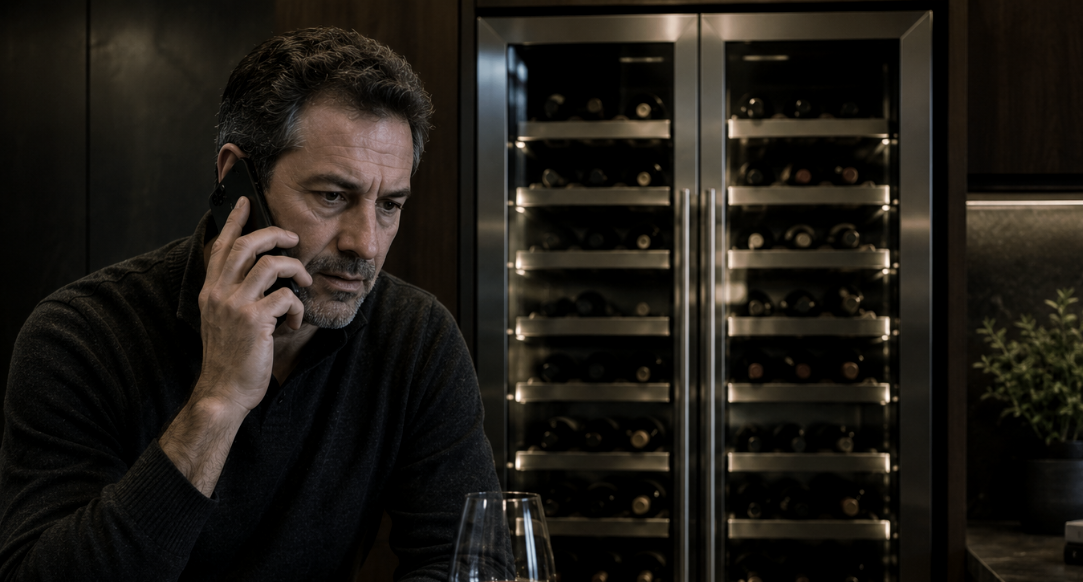
Built-in wine cooler problems rarely begin with complete shutdown. Most systems keep running while cooling performance slowly falls out of balance.
We provide professional service for built-in wine refrigeration systems in Miami focused on restoring stable cooling, balanced airflow, and reliable wine storage conditions — not simply making the cabinet feel cold again.
Why Built-In Wine Coolers Fail Differently
| System Area | Why It Matters |
|---|---|
| Front ventilation | Releases trapped heat from the cabinet |
| Internal airflow | Keeps shelf temperatures balanced |
| Temperature sensors | Control cooling recovery and cycling |
| Door sealing | Protects humidity and prevents warm-air intrusion |
| Cabinet integration | Affects ventilation and heat buildup |
| Compressor cycling | Maintains long-term cooling consistency |
When one part falls out of balance, the cooler may continue running while storage performance slowly becomes less reliable.
Built-In Wine Cooler Systems We Service
We service built-in wine refrigeration systems commonly installed in Miami homes, condos, hospitality spaces, and designer kitchens.
Service includes:
- built-in wine coolers
- undercounter wine refrigerators
- dual-zone wine coolers
- panel-ready wine refrigeration
- integrated wine storage systems
- wine cabinets
- beverage and wine combination units
- luxury residential wine refrigeration
- compact built-in wine coolers
- column wine refrigeration where applicable
Many systems operate inside tightly integrated cabinetry where airflow and heat rejection become critical during long Miami cooling cycles.
If the exact model number is unavailable, a photo of the model tag is usually enough to identify the platform correctly.
Premium Wine Cooler Brands We Repair
We work with many premium and built-in wine refrigeration brands commonly found in Miami kitchens and hospitality environments.
Built-In & Luxury Residential Wine Systems
Liebherr • Thermador • Miele • Viking • JennAir • Bosch • KitchenAid • U-Line • Vinotemp • Monogram • Dacor • Fisher & Paykel • Gaggenau • True Residential • Marvel • XO • Avallon • Zephyr • EuroCave where applicable
Commercial Wine Storage & Hospitality Refrigeration
True • Perlick • Hoshizaki • Beverage-Air • Traulsen • Turbo Air
The actual failure pattern usually matters more than the logo itself.
Airflow design, cabinet ventilation, recovery response, humidity management, and cooling distribution often reveal more than the brand badge alone.
What Homeowners Usually Notice First
Most built-in wine cooler problems begin as small changes in cabinet operation rather than complete failure.
| What You Notice | What It Usually Means | Priority |
|---|---|---|
| Upper shelves feel warmer | Internal airflow imbalance | High |
| Cooling takes longer after opening | Recovery response weakening | Medium |
| Wine cooler runs constantly | Heat rejection or airflow stress | High |
| Glass develops condensation | Humidity or seal instability | Medium |
| Light frost begins forming | Airflow or moisture imbalance | High |
| One zone drifts more than the other | Dual-zone distribution issue | Medium |
| New vibration or buzzing appears | Fan or compressor strain | Medium |
| Cabinet feels “almost cold enough” | Early cooling efficiency decline | High |
Most homeowners notice something feels different before the wine cooler fully stops cooling.
Why Miami Conditions Matter
Built-in wine refrigeration systems in Miami often operate under heavier environmental load than systems in cooler climates.
Humidity stays high longer. Kitchens remain warmer. Condo cabinetry tends to run tighter. Waterfront properties introduce additional moisture and salt exposure around ventilation areas.
That matters because built-in systems already work with limited airflow margins.
Miami conditions commonly increase condensation load, runtime stress, ventilation sensitivity, compressor cycling, recovery time after openings, and hidden moisture buildup inside cabinetry.
Vacation properties can make problems harder to catch early because systems may drift for weeks before anyone notices changing storage conditions.
Real Built-In Wine Cooler Problems We Repair
Built-In Wine Cooler Runs Constantly
A system that no longer shuts off is usually losing its ability to maintain storage conditions efficiently.
The cabinet may still cool, but recovery slows, vibration becomes more noticeable, and the compressor rarely seems to rest anymore.
Common causes include:
- restricted front ventilation
- dirty condenser surfaces
- trapped cabinet heat
- weak airflow circulation
- sensor drift
- declining compressor efficiency
- overloaded shelving blocking airflow
The important question is not whether the cooler still turns on.
The real question is why the system can no longer recover normally under everyday use.
A successful repair should restore believable cycling, quieter operation, and cooling that no longer feels stuck in constant catch-up mode.
Upper Shelves Warm / Lower Shelves Cold
Uneven shelf temperature usually means the unit is producing cold, but not distributing it correctly.
The cooler still appears operational, but bottle temperatures become less consistent throughout the cabinet.
Many homeowners first notice:
- whites not feeling cold enough
- upper bottles warming faster
- uneven temperatures between shelves
- slower cooling after loading new bottles
Common causes include:
- weak circulation fans
- blocked airflow channels
- evaporator airflow restriction
- dual-zone balancing problems
- sensor-related cycling irregularities
The issue is often not whether cold air exists — but whether it is still moving correctly through the cabinet.
Repair should restore balanced shelf temperatures and predictable cooling recovery throughout the system.
Condensation Around the Door or Glass
Moisture around the glass or cabinet edges usually means humidity control has started drifting out of range.
In Miami environments, this often becomes worse during long humid weather periods or heavy kitchen use.
Common causes include:
- gasket leakage
- partial door misalignment
- repeated warm-air intrusion
- unstable recovery cycles
- airflow imbalance inside the cabinet
Many systems continue cooling while moisture control slowly becomes less reliable.
The goal is not simply drying the cabinet temporarily.
The goal is restoring predictable humidity response during real daily operation.
Frost Buildup Inside the Wine Cooler
Frost is usually a warning that airflow or moisture management is beginning to break down.
Many homeowners first notice light ice buildup before temperatures become obviously unstable.
Common causes include:
- warm-air intrusion
- weak internal airflow
- gasket leakage
- evaporator airflow restriction
- unstable defrost operation
- sensor timing irregularities
What matters most is understanding why frost keeps returning — not simply removing visible ice.
Proper correction should restore airflow consistency and prevent cooling performance from falling off again after the next operating cycle.
Built-In Wine Cooler Loud or Vibrating
A change in sound is often one of the first signs that the system is operating under stress.
Many built-in wine coolers become noisier before storage performance noticeably declines.
Common causes include:
- fan strain
- cabinet vibration transfer
- uneven leveling
- restricted ventilation
- longer compressor runtimes
- internal airflow obstruction
Sometimes the sound itself is minor.
The real concern is the operating condition creating the noise.
Service should leave the system sounding steadier, smoother, and less strained during normal daily use.
Dual-Zone Wine Cooler Problems
Dual-zone systems often develop uneven performance before complete cooling loss appears.
One section may recover slower, drift warmer, or behave differently even while the other zone still feels mostly normal.
Common symptoms include:
- one zone warmer than the other
- unstable upper-zone temperatures
- slower recovery in one compartment
- inconsistent bottle temperatures
- display readings that no longer match cabinet feel
Common causes include:
- airflow imbalance
- sensor drift
- circulation irregularities
- control-side communication faults
- cooling distribution issues
The objective is restoring believable balance between both storage zones — not simply making one side cold again.
What “Fixed” Should Actually Mean
A built-in wine cooler should not simply restart and temporarily feel cold.
After proper repair, the system should consistently return to reliable operation under normal daily use.
| Verified Result | What It Actually Means |
|---|---|
| Even shelf temperatures | Airflow is circulating correctly |
| Faster cooling recovery | The system is handling normal use again |
| Less nonstop runtime | Heat rejection and cycling improved |
| Reduced vibration | Components operate under less stress |
| Dry cabinet interior | Humidity control is restored |
| Balanced dual-zone performance | Both compartments recover correctly |
| Display matches real conditions | Sensors and controls respond accurately |
| Wine storage feels dependable again | The cabinet can be trusted day to day |
That is a stronger standard than simply saying the wine cooler turns back on.
Genuine OEM Parts — When Wine Storage Depends on Precision
Wine refrigeration systems are sensitive to airflow, temperature management, and cycling response.
An incorrect fan, sensor, board, or airflow-related component may create unstable shelf temperatures, repeated condensation, abnormal runtime, uneven dual-zone performance, recurring faults, or unreliable recovery cycles.
When replacement is truly necessary, genuine OEM parts are prioritized whenever possible and matched to the correct platform configuration.
Why Homeowners Choose Us for Built-In Wine Cooler Repair in Miami
Built-in wine refrigeration problems are rarely just “one bad part.”
In Miami, humidity, enclosed cabinetry, long cooling cycles, and environmental stress often create layered issues that continue returning when the real cause is missed.
That is why service should feel calm, exact, airflow-aware, cabinet-safe, and system-focused.
That means:
- real diagnosis instead of restart-and-hope
- careful handling around premium cabinetry
- attention to airflow and humidity control
- performance verification before completion
- experience with luxury built-in wine refrigeration systems
- cooling recovery confirmed before the visit is closed
Wine storage should feel dependable — not something homeowners constantly monitor or second-guess.
FAQ — Built-In Wine Cooler Repair in Miami, FL
Q: Why is my built-in wine cooler running constantly?
A: Usually because airflow, ventilation, condenser efficiency, or recovery response has fallen out of balance.
Q: Why are upper shelves warmer than lower shelves?
A: This often points to airflow circulation problems or uneven cooling distribution inside the cabinet.
Q: Is condensation on the glass normal?
A: Light moisture may appear during humid conditions, but repeated condensation usually indicates humidity imbalance or seal-related problems.
Q: Why does my wine cooler get louder at night?
A: Compressor and airflow sounds become more noticeable when ambient noise drops, though increasing vibration may also indicate cooling stress.
Q: Can built-in wine coolers be serviced without damaging cabinetry?
A: Yes. Built-in systems require careful access planning to protect surrounding finishes, panels, and flooring.
Q: Are dual-zone wine coolers harder to repair?
A: Dual-zone systems involve additional airflow balancing, sensors, and cooling-management logic compared to single-zone systems.
Q: Are built-in wine cooler repairs usually worth it?
A: Many premium built-in systems are worth repairing because replacement often involves cabinetry modifications and installation work.
Q: Do condo kitchens create additional cooling stress?
A: Yes. Tight cabinetry and reduced ventilation space may increase refrigeration workload over time.
Miami Areas We Serve
We provide built-in wine cooler repair throughout Miami and surrounding luxury residential and hospitality areas.