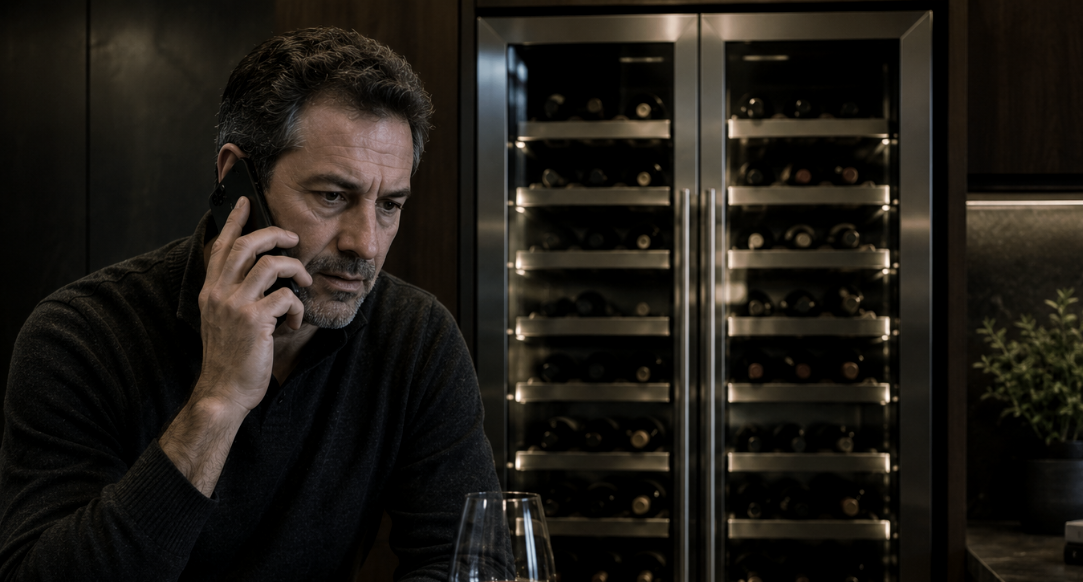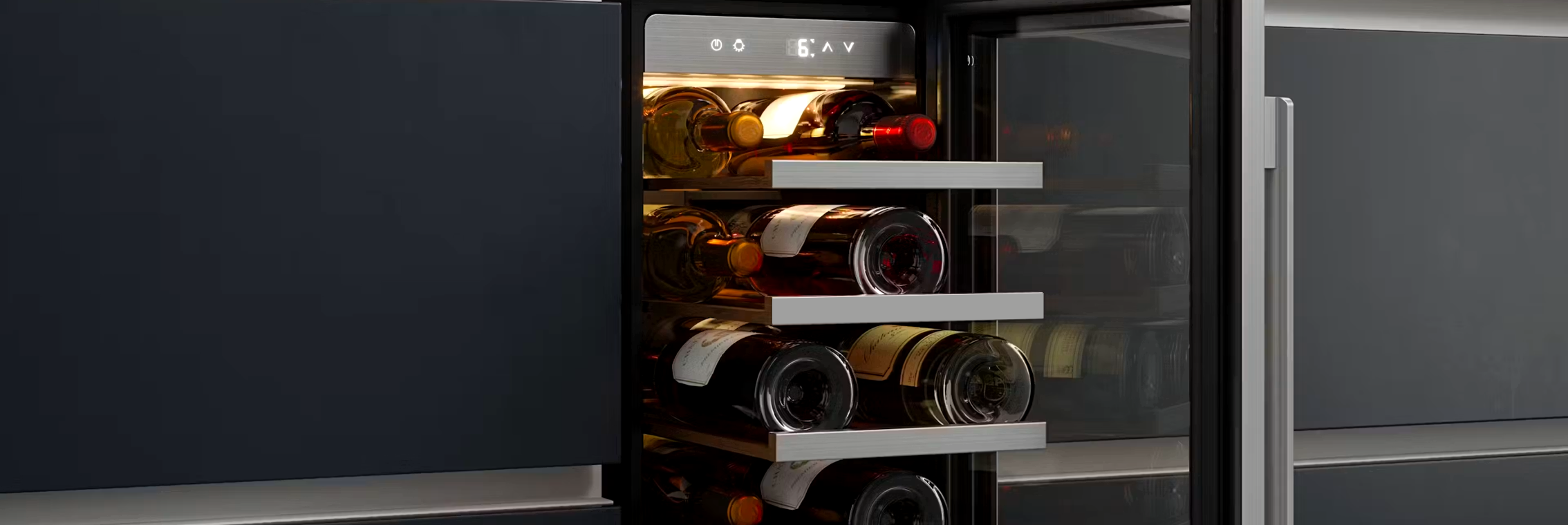
The display says 55°F. An hour later it says 58, then 53, then 57. Watching a wine cooler’s temperature bounce is unsettling — sometimes for good reason, often for none at all.
Here’s how to tell a normal cycle from a real swing, and what steadies the ones that matter.
Swings getting wider? Call 786-377-9387 or book a same-day visit.
First, make sure this is your problem
- Never reaches the setpoint at all → see running but not cold enough.
- One zone swings, the other holds → see dual-zone: one zone warm.
- Reaches temperature but bounces around it → you’re in the right place.
Quick diagnosis: swing pattern → what it means
| Pattern | What it means | Priority |
|---|---|---|
| ±2–3°F in slow, regular waves | Normal cooling cycles — air breathing, wine steady | None |
| Swings of 5°F+ sustained | Seal leak, coils, or a struggling system | Medium |
| Spike after every door opening | Normal — watch recovery time, not the spike | None |
| Swings only on hot afternoons | Ambient ceiling — placement or capacity | Medium |
| Display steady, thermometer swings | Sensor reading the wrong spot — or failing | High |
| Swings widening month over month | Capacity eroding — the trend is the message | High |
Air swings. Wine doesn’t.
- The display measures air — the fastest-moving, least important temperature in the cabinet.
- Wine is a thermal flywheel — a bottle takes hours to move one degree; the liquid ignores the cycles the display dramatizes.
- Cycling is how cooling works — compressor on, air dips; compressor rests, air drifts; the wave is the design.
- The worry line is 5°F sustained — swings that size, held for days, start working the corks.
- The real thermometer is in the bottle — a probe in a water glass on the shelf shows what the wine feels; it’s boringly stable in a healthy unit.
Steady it: checks in order
- Log 48 hours first. A cheap thermometer with min/max memory turns anxiety into data — premium columns that log internally, Miele among them, make this a button press.
- Bill-test the gasket. A seal leak is the top cause of real swings — warm air surges in with every compressor rest.
- Vacuum the coils. A struggling condenser stretches every recovery, and stretched recoveries read as swings.
- Check the load. A near-empty cabinet has no thermal mass — every door opening moves it; bottles are ballast.
- Check the placement. Sun in the afternoon or a heat-producing neighbor writes daily waves into the log.
- Stop chasing the setpoint. Nudging the control after every reading adds your swings to the machine’s — set 55°F and leave it a week.
Log shows real swings? Call 786-377-9387 or book a diagnostic online.
When do swings actually hurt the wine?
- Swings pump the cork. Warm cycles push air out past it, cool cycles pull air in — oxidation by breathing, repeated daily.
- Days matter, hours don’t. A rough afternoon is nothing; a month of 8°F daily waves is real aging.
- Excursions above 70°F count double — heat accelerates everything the swing started.
- Stability beats precision — a steady 58°F outperforms a bouncing 55°F; the full numbers live in the storage temperature guide.
The Miami factor
- Afternoons write the wave. Ambient peaks across Miami put a daily bump in every marginal unit’s log.
- Glass towers swing hardest. A cabinet near floor-to-ceiling glass in Brickell rides the sun’s schedule, not the thermostat’s.
- Storm blinks scramble controls. A post-outage unit running default settings swings until someone notices — check after every blink.
- Humidity hides in the swing. Every warm phase pulls moist air in; the swing that ages wine also feeds the fog and frost stories.
When to stop DIY and call a technician
The log, the seal, and the coils are yours; past that starts professional wine cooler repair:
- Real swings survive clean coils and a tight seal — sensor drift and refrigerant charge are next, and both are meter work.
- The display and thermometer disagree — a sensor reading the wrong truth steers the whole system wrong; premium cabinets with dual sensors, Liebherr among them, get this diagnosed from their own logs.
- Swings widen month over month — the trend line is capacity eroding, and gauges read the cause in minutes.
- A dual-zone swings in both zones at once — shared-cold designs swing from the damper; that’s single and dual zone wine cooler repair scope.
Trend still climbing? Call 786-377-9387 or book the visit.
Keep it steady
- Keep the cabinet ⅔ full or better — thermal mass is the cheapest stabilizer ever invented.
- Decide before you open — recovery time, not the spike, is what door discipline buys.
- Verify monthly with min/max memory — one reading a month beats a hundred anxious glances.
- Leave the setpoint alone — the steadiest cabinets belong to owners who stopped touching the buttons.
- Check after storms and trips — defaults and setbacks are how quiet swings begin.
FAQ: wine cooler temperature fluctuating
Q: Why does my wine fridge temperature keep changing?
A: Small regular waves are the cooling cycle working; real swings of 5°F+ point to the seal, the coils, or a failing sensor. Log 48 hours before fixing anything.
Q: How much fluctuation is normal in a wine cooler?
A: ±2–3°F of air temperature around the setpoint is normal cycling. The wine itself moves far less — bottles smooth out what the display shows.
Q: Does fluctuating temperature ruin wine?
A: Sustained big swings do — they pump air past the cork and accelerate aging. Occasional spikes from door openings or one hot afternoon don’t.
Q: Why does the display say one thing and my thermometer another?
A: The sensor reads one spot of air; your thermometer reads another — small gaps are normal. A consistent gap of 5°F+ means the sensor or its calibration has drifted.
Q: Why is my wine fridge temperature swinging more in summer?
A: Ambient heat shrinks the unit’s reserve, so every recovery takes longer and reads as a wider wave. If night restores steadiness, it’s the season; if not, capacity is slipping.