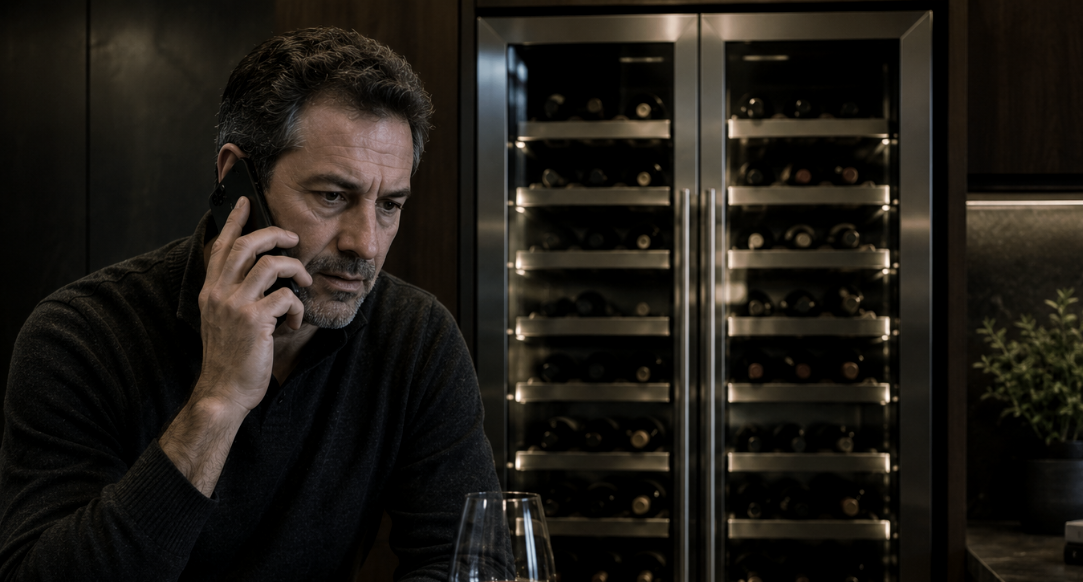
Wine cellar problems rarely begin with total cooling failure.
Most systems continue running while temperature drift, humidity imbalance, and uneven airflow gradually affect the storage environment.
The room may feel cool and the controller may look normal, but real bottle conditions become less predictable over time.
We provide professional Wine Cellar Cooling System Repair in Miami focused on restoring stable climate behavior, balanced humidity, and reliable long-term wine preservation — not simply lowering the temperature again.
Why Wine Cellar Systems Fail Differently
Wine cellar refrigeration is fundamentally different from standard wine coolers.
A cellar is not a cabinet.
It is a controlled storage environment where cooling performance, humidity management, insulation behavior, air exchange, thermal load, and room volume all interact together continuously.
| Wine Cellar Factor | Why It Matters |
|---|---|
| Room volume | Larger spaces recover slower |
| Insulation quality | Affects thermal stability |
| Vapor barrier integrity | Controls moisture migration |
| Evaporator airflow | Keeps cellar temperatures balanced |
| Humidity behavior | Protects cork and wine condition |
| Glass exposure | Adds thermal load |
| Door usage frequency | Changes recovery timing |
| Ceiling height | Alters circulation patterns |
| Rack density | Influences airflow movement |
| Split-system configuration | Changes cooling distribution |
Most wine cellar failures develop gradually because environmental instability appears before total cooling loss.
Wine Cellar Systems We Service
We service many residential and commercial wine cellar cooling systems throughout Miami luxury homes, restaurants, hospitality spaces, wine rooms, and collector installations.
Service includes:
- residential wine cellars
- luxury wine rooms
- walk-in wine cellars
- glass wine cellars
- custom wine storage rooms
- split-system wine cellars
- ducted wine cellar systems
- self-contained wine cellar units
- ceiling-mounted cellar cooling systems
- through-wall cellar cooling systems
- commercial wine storage rooms
- hospitality wine cellars
- tasting-room wine refrigeration
- collector-grade wine storage environments
Cellar systems often involve very different cooling behavior depending on room size, insulation quality, and environmental exposure.
Wine Cellar Brands & Cooling Systems We Repair
We work with many premium wine cellar refrigeration systems commonly installed in Miami residential and hospitality environments.
Luxury Residential Wine Cellar Systems
Wine Guardian • WhisperKOOL • Gaggenau • CellarPro • Breezaire • EuroCave • True • Wine-Mate • KoolR • US Cellar Systems • Viking
Commercial & Hospitality Wine Storage
Wine Guardian Commercial • CellarCool • Split refrigeration cellar systems • Custom-engineered wine room cooling platforms
Custom Cellar Installations
Ducted cellar cooling systems • Ceiling cassette cellar refrigeration • Remote condenser cellar systems • Split evaporator cellar units
In wine cellar environments, installation behavior and environmental interaction often matter just as much as the cooling hardware itself.
What Homeowners Usually Notice First
Wine cellar instability usually appears through environmental behavior rather than sudden shutdown.
| What You Notice | What It Usually Means | Priority |
|---|---|---|
| Cellar feels slightly warmer during the day | Thermal-load recovery weakening | High |
| Humidity starts fluctuating | Moisture-control imbalance | High |
| Glass walls develop condensation | Vapor-barrier or airflow instability | Medium |
| Cooling cycles become longer | Environmental stress increasing | High |
| Different cellar areas feel uneven | Circulation imbalance | Medium |
| Bottles near the ceiling feel warmer | Vertical thermal stratification | Medium |
| Cellar cools overnight but drifts during daytime | Heat-load recovery weakness | High |
| System never seems to rest | Continuous environmental compensation | High |
| Cork condition starts changing | Humidity stability declining | High |
Most cellar systems remain operational while preservation conditions slowly become less controlled.
Why Miami Conditions Matter for Wine Cellars
Miami is one of the hardest environments for stable wine cellar performance.
Outdoor humidity remains high for long periods. Heat load accumulates throughout the day. Glass-heavy architecture increases solar gain. Waterfront homes introduce additional moisture pressure around cellar structures.
That matters because wine cellar cooling systems manage an entire environment — not just refrigerated air.
Miami conditions commonly increase:
- humidity migration
- thermal infiltration
- condenser stress
- long-cycle runtime
- recovery delay
- vapor-barrier pressure
- glass condensation
- uneven room stabilization
- insulation fatigue
- moisture accumulation behind walls
Wine cellar systems in Miami often fail progressively under environmental load long before complete cooling loss becomes obvious.
Real Wine Cellar Problems We Repair
Wine Cellar Temperature Drifts During the Day
This is one of the most common early-stage wine cellar complaints.
The cellar may appear stable overnight, then slowly lose consistency as thermal demand builds during daytime conditions.
Common causes include:
- declining cooling efficiency
- insulation weakness
- glass thermal gain
- condenser overheating
- extended runtime stress
- improper airflow balancing
- oversized environmental load
The issue is not whether the cellar cools eventually.
The issue is whether the environment remains stable continuously throughout the day.
Wine Cellar Humidity Too High or Too Low
Humidity instability is often more damaging long-term than temperature drift itself.
Excessively dry conditions may affect cork integrity. Excessive humidity may create condensation, mold pressure, or moisture instability throughout the cellar.
Common causes include:
- evaporator imbalance
- vapor-barrier weakness
- uncontrolled air exchange
- improper airflow movement
- drainage-related moisture problems
- oversized or undersized cooling configuration
Wine preservation depends on stable environmental behavior — not temperature alone.
Glass Wine Cellar Condensation Problems
Modern Miami wine rooms often use large glass panels, frameless doors, and display-style architecture.
These systems are visually impressive but thermally demanding.
Common causes include:
- warm-air intrusion
- humidity imbalance
- glass thermal bridging
- unstable recovery cycles
- vapor-barrier weakness
- uneven circulation around glass surfaces
Condensation usually signals that environmental balance is beginning to break down somewhere inside the cellar system.
Wine Cellar Cooling System Runs Constantly
Wine cellar systems naturally run longer than residential refrigerators, but nonstop operation usually indicates environmental overload or inefficient recovery behavior.
Common causes include:
- excessive room heat load
- condenser-side stress
- airflow restriction
- poor insulation performance
- leaking door seals
- thermal infiltration
- system undersizing
The real concern is not runtime itself.
The concern is whether the cellar can still maintain stable preservation conditions efficiently.
Uneven Temperature Between Wine Cellar Areas
Larger wine rooms often develop environmental separation between different sections of the cellar.
Upper storage may warm first. Corners may recover slower. Glass-facing areas may behave differently than insulated wall sections.
Common causes include:
- airflow imbalance
- improper evaporator distribution
- ceiling heat accumulation
- rack-density restriction
- long circulation paths
- thermal stratification
A healthy wine cellar should stabilize as a unified environment rather than separate hot and cold zones.
Wine Cellar System Short Cycling
Short cycling places significant stress on cellar refrigeration systems because the environment never stabilizes fully before shutdown occurs again.
Common causes include:
- incorrect sizing
- thermostat instability
- sensor placement problems
- airflow restriction
- control-board irregularities
- condenser overheating
Stable cellar operation depends on controlled environmental cycling — not rapid temperature swings.
Wine Cellar Not Recovering After Door Openings
Large cellar doors and frequent access create major environmental disruption.
A healthy system should recover predictably without remaining unstable for extended periods afterward.
Common causes include:
- weak cooling recovery
- poor circulation balancing
- excessive room heat load
- oversized glass exposure
- declining compressor efficiency
- environmental leakage
Long delayed recovery usually signals a deeper environmental-control issue.
Ducted vs Self-Contained Wine Cellar Systems
Different cellar refrigeration architectures fail differently.
| System Type | What Usually Matters |
|---|---|
| Self-contained cellar system | Ventilation and heat rejection |
| Ducted wine cellar cooling | Airflow balancing and distribution |
| Split-system cellar refrigeration | Refrigerant-side performance and long-cycle stability |
| Ceiling-mounted systems | Vertical circulation behavior |
| Remote condenser systems | Heat rejection under Miami ambient load |
The first question is not simply whether the cellar is cooling.
The first question is how the cellar is designed to manage environmental stability.
Large Wine Cellars vs Small Wine Rooms
Wine cellar behavior changes dramatically depending on room volume and storage scale.
Small Wine Rooms
Smaller cellars react faster to:
- door openings
- humidity fluctuation
- ambient heat changes
- airflow imbalance
Large Wine Cellars
Larger cellar environments often hide instability longer because:
- thermal mass delays visible changes
- room volume stabilizes slowly
- environmental drift develops gradually
- different room sections respond independently
Large wine cellars may appear stable while preservation conditions slowly move outside intended ranges.
What “Fixed” Should Mean for a Wine Cellar
A wine cellar is not properly repaired simply because the room feels cooler again.
After proper repair, the environment should return to stable preservation behavior under real daily conditions.
| Verified Result | What It Actually Means |
|---|---|
| Temperature remains consistent throughout the cellar | Environmental balance restored |
| Humidity remains predictable | Preservation conditions stabilized |
| Glass condensation no longer returns | Moisture behavior corrected |
| Cooling cycles normalize | Recovery performance improved |
| Upper and lower cellar areas stay closer in temperature | Circulation stabilized |
| Daytime drift becomes smaller | Thermal-load handling improved |
| System runtime becomes more controlled | Environmental efficiency restored |
| Wine storage feels dependable again | Long-term preservation conditions stabilized |
That is a stronger standard than simply saying the cellar cools again.
Why Homeowners Choose Us for Wine Cellar Cooling System Repair in Miami
Wine cellar systems require environmental diagnosis — not appliance-level troubleshooting.
The system must be evaluated as a complete climate-controlled structure involving refrigeration behavior, room conditions, humidity response, insulation interaction, airflow movement, and thermal recovery timing.
That means:
- real environmental evaluation
- airflow and circulation analysis
- humidity-behavior verification
- thermal-load assessment
- cooling recovery testing
- careful work around luxury wine collections
- experience with high-end wine cellar systems
- performance confirmation before completion
A wine cellar should preserve stability quietly in the background — not become something constantly monitored or adjusted.
FAQ — Wine Cellar Cooling System Repair in Miami, FL
Q: Why does my wine cellar feel warmer during the afternoon?
A: Thermal load often increases throughout the day from ambient heat, glass exposure, and environmental recovery stress.
Q: Is humidity fluctuation dangerous for wine storage?
A: Yes. Long-term humidity instability may affect cork condition and overall storage reliability.
Q: Why is condensation forming on the cellar glass?
A: Usually because humidity balance, airflow movement, or thermal separation around the glass has become unstable.
Q: Why does my cellar system run constantly?
A: Wine cellar systems naturally operate longer, but nonstop runtime usually points to environmental overload or inefficient cooling recovery.
Q: Why are some cellar sections warmer than others?
A: Large wine rooms may develop airflow imbalance or vertical thermal stratification between storage areas.
Q: Are split-system wine cellars harder to repair?
A: Split systems require additional refrigeration-side diagnosis and environmental balancing compared to self-contained units.
Q: Can wine cellar insulation problems affect cooling performance?
A: Yes. Weak insulation or vapor-barrier failure may dramatically increase environmental instability and system workload.
Q: Are wine cellar repairs usually worth it?
A: Often yes, especially for luxury wine rooms and collector-grade storage environments where replacement costs are substantial.
Miami Areas We Serve
We provide wine cellar cooling system repair throughout Miami and surrounding luxury residential and hospitality areas.