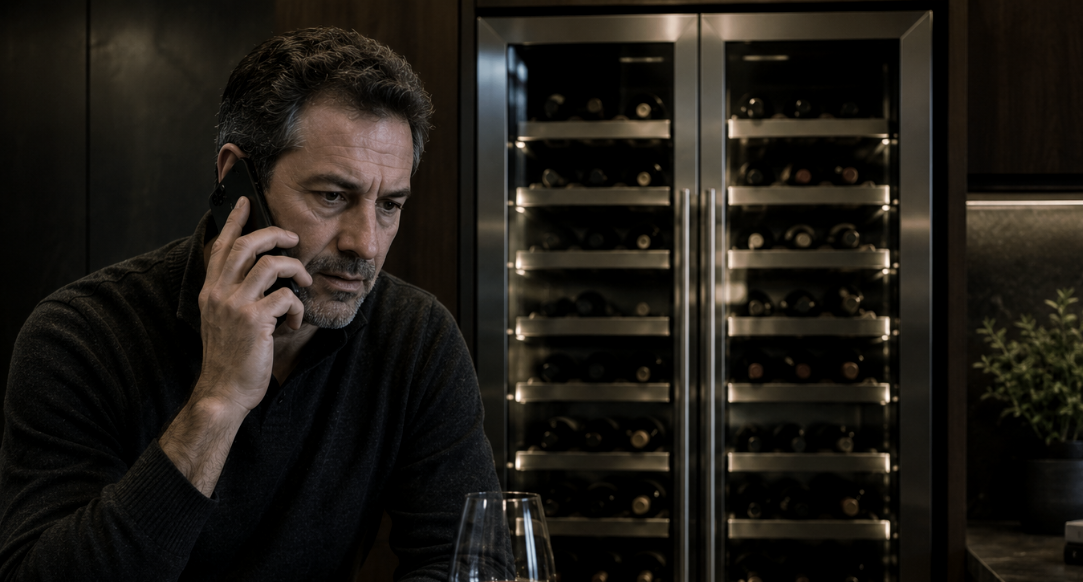
Power’s back, the microwave clock is blinking — and the wine cooler is either silent, blinking defaults, or plugged in but showing no power at all.
Most post-outage problems resolve with one correct reset. Here’s the order that separates a five-minute fix from real storm damage.
Cooler dead after the storm? Call 786-377-9387 or book a same-day visit.
First, make sure this is your problem
- The cooler ran fine through the outage but won’t get cold now → work through why a wine cooler stops cooling.
- It restarted but clicks every few minutes → that’s compressor hot or clicking territory.
- Power just came back and you’re standing in front of the unit → you’re in the right place.
Quick diagnosis: post-outage symptom → what it means
| What you see | What it means | Priority |
|---|---|---|
| Plugged in, no power, no lights | Tripped breaker, GFCI, or a board that needs a hard reset | High |
| Display on but showing default settings | Controls reset in the outage — your setpoints are gone | Low |
| Runs, but warm for the first hours | Normal pulldown — the cabinet lost its cold, not its health | None |
| Clicks every few minutes, won’t stay running | Hot-start stress on the relay or compressor | High |
| Breaker trips again when it starts | Surge damage or a shorted winding — stop restarting | High |
| Display garbled or frozen | Board took the surge — hard reset first, then diagnosis | Medium |
The first 30 minutes: reset it right
- Check the breaker and any GFCI outlet first. Half of “dead after outage” units are a tripped kitchen GFCI — press reset on the outlet before blaming the machine.
- Do a real hard reset: unplug for 15 minutes. The control board’s memory needs several minutes fully dark to clear — a ten-second unplug resets nothing.
- Re-enter your setpoints. Outage-reset controls restart at factory defaults — board-controlled built-ins, JennAir columns among them, will happily run “demo-cold” or default warm until told otherwise.
- Listen to the first ten minutes. A smooth hum settling into quiet running is a healthy restart; a click-hum-silence loop means the compressor is hot-starting against pressure — unplug and give it 30 minutes.
- Give it a real pulldown window. 12–24 hours to recover cellar temperature is normal after a long outage — judge nothing before the next morning.
- Verify with a thermometer, not the display. A surge-shaken sensor can read wrong while looking confident — one cheap thermometer settles it overnight.
Reset done and still nothing? Call 786-377-9387 or book a diagnostic online.
Why do outages hurt wine coolers so much?
- The restart is the hardest start. Power returning while the system still holds pressure forces the compressor to start against its own head — the single most stressful moment in its life.
- The surge rides in with the power. The voltage spike when the grid comes back kills more control boards than the outage itself ever does.
- Brownouts are worse than blackouts. Half-voltage makes motors strain instead of stopping — a flickering evening does more winding damage than a clean six-hour outage.
- Repeated blinks multiply the damage. Five one-minute blinks mean five hot restarts; one long outage means one — the grid’s worst gift is instability, not absence.
- Generators bring their own spikes. Transfer switching hits appliances twice — going on generator and coming off — and cheap portable units add dirty voltage in between.
Was the wine harmed?
- Hours are harmless. A closed, reasonably full cabinet climbs only a few degrees in a half-day outage — thermal mass is your insurance policy.
- Days start the clock. A cabinet that sat at 75°F+ for several days aged its contents measurably — drink those bottles sooner rather than cellaring them longer.
- Look for pushed corks. Corks lifted above the lip or seepage at the capsule mean heat expanded the wine — those bottles are the casualties to open first.
- Taste before you mourn. “Cooked” wine shows flat aromas and stewed fruit; plenty of collections survive a week-long outage with nothing worse than a story.
- Document for insurance. Photos of the thermometer, the outage dates, and receipts for valuable bottles — homeowner policies differ on wine, and a log is what claims are built from.
Storm season in Miami: the local reality
- June through November is restart season. Afternoon storms blink the grid across Miami weekly — every blink is a hot restart unless a delay device absorbs it.
- High-rises add elevator-room politics. Building generator transfers in Downtown Miami towers cycle power in ways unit owners never see coming.
- Vacation homes fail silently. An August outage in an empty residence means weeks at 85°F before anyone notices — a Wi-Fi thermometer is the cheapest guardian a collection can have.
- Bars restart under load. Commercial boxes ride outages better mechanically, but their digital controllers still wake up in defaults — glass-door units, Hoshizaki among them, need their setpoints checked before the evening rush.
When to stop DIY and call a technician
The reset sequence is yours; what survives it is professional wine cooler repair:
- No power after breaker, GFCI, and a 15-minute reset — the board or its power supply took the surge, and boards are diagnosed with a meter, not more resets.
- Clicking continues past the first hour — hot-start stress has moved into the relay or windings; every further attempt burns margin a technician could have saved.
- The breaker trips on every start — that’s a short, and repeated resets feed it; stop and unplug.
- It runs but never recovers temperature in 24 hours — the outage may have finished a refrigerant leak that was already in progress; gauges will say in minutes.
Surge-damaged boards and hot-start casualties are daily scope for thermoelectric and compressor wine cooler repair every storm season.
Storm took the cooler with it? Call 786-377-9387 or book the repair.
Storm-season readiness
- Install a surge protector with restart delay. It absorbs the return spike and holds the restart until pressure equalizes — the single best $40 a Miami wine owner spends.
- Add a Wi-Fi thermometer inside the cabinet. It turns a silent failure into a phone alert, which matters most for seasonal homes.
- Keep the cabinet at least three-quarters full. Bottles are thermal mass — a full cabinet rides out an outage a half-empty one can’t.
- Label the cooler’s breaker now. Finding the right switch by flashlight during a storm is not the moment for discovery.
- Book the pre-season checkup in May. A unit going into Miami’s brutal months with clean coils and a verified charge shrugs off what kills neglected ones.
FAQ: wine cooler after a power outage
Q: Why is my wine cooler not working after a power outage?
A: Check the breaker and GFCI, then unplug for a full 15 minutes so the control board actually clears. If it’s still dead after that, the board or its power supply likely took the return surge.
Q: Do I need to reset my wine cooler after power comes back?
A: Often yes — controls restart at factory defaults, so verify your setpoints. A hard reset only counts if the unit stays unplugged for several minutes.
Q: How long can wine survive without cooling?
A: A closed, full cabinet holds safe temperatures for the better part of a day. Damage risk starts when the wine itself spends days above 70°F — hours don’t harm it.
Q: Should I unplug my wine cooler during a storm?
A: If you’re home and outages are rolling through, yes — unplugging skips the return surge entirely, and the cabinet’s thermal mass covers the gap. Plug back in once power is stable.
Q: Why does my wine cooler keep tripping the breaker after an outage?
A: A start against a short — surge-damaged windings or board — trips it every time. Stop restarting; each attempt deepens the damage before the diagnosis.