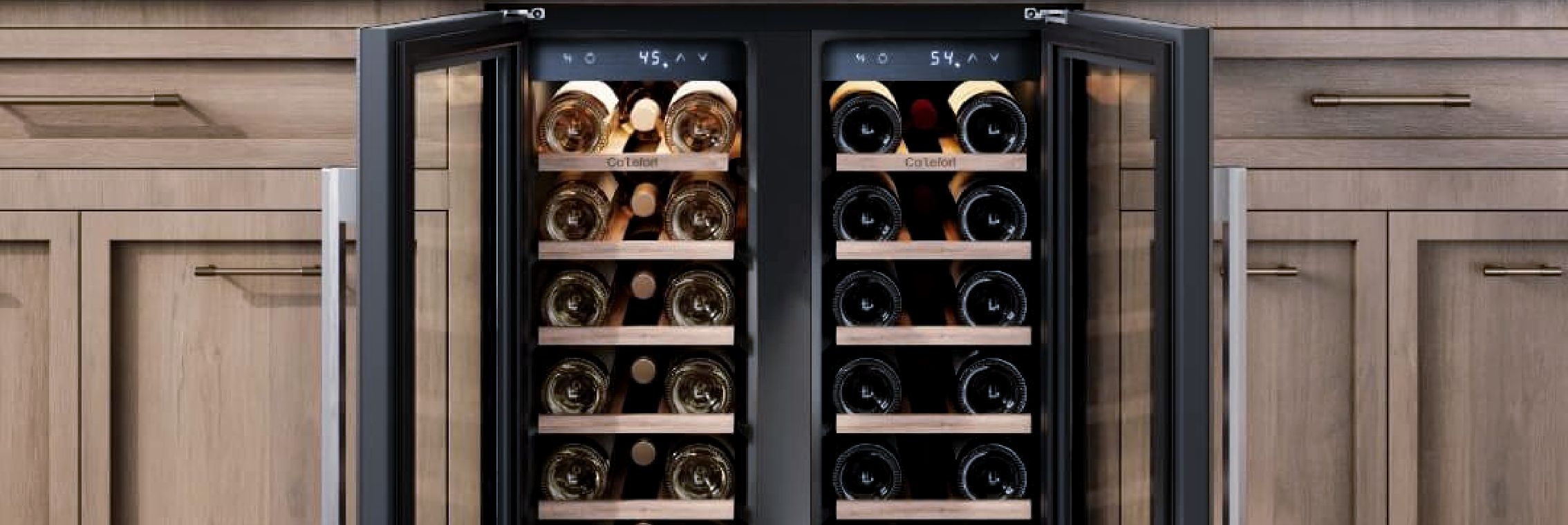
Reds at 64°F on top, whites at 46°F below — that’s the whole point of a dual-zone cooler. Until one zone quietly gives up and both shelves drift to the same temperature.
One warm zone is a specific fault with a short suspect list. Here’s how to narrow it down.
Zone full of expensive bottles? Call 786-377-9387 or book a same-day visit.
First, make sure this is your problem
- Both zones warm, nothing cooling → start with why a wine cooler stops cooling.
- Both zones cool but stall short of the setpoint → see running but not cold enough.
- One zone warm, the other fine (or one won’t stop cooling) → you’re in the right place.
Quick diagnosis: symptom → likely cause
| What you see | Most likely cause | Priority |
|---|---|---|
| One zone warm, drifts toward the other zone’s temp | That zone’s circulation fan has died | High |
| Zone 1 won’t stop cooling, zone 2 doesn’t cool | Damper stuck or zone sensor failed | High |
| Zone reads a fixed, wrong number | Thermistor failure in that zone | High |
| Zones can’t hold different temps anymore | Divider seal worn — zones bleeding into each other | Medium |
| Both zones erratic, display glitches | Control board fault | High |
| Upper zone slightly warmer, always was | Normal — heat rises, small offset is by design | None |
How a dual-zone actually splits the cold
Knowing your unit’s design tells you what can break. There are two architectures:
- Two independent systems. Premium cabinets — Liebherr’s Vinidor line is the textbook case — give each zone its own evaporator and controls. One zone failing while the other purrs points straight at that zone’s fan or sensor.
- One system, shared cold. Most mid-range units — including many Vinotemp dual-zones — cool one zone directly and feed the other through a damper and fan. A stuck damper starves one zone and freezes the other: the classic “zone 1 won’t stop cooling, zone 2 doesn’t cool” forum complaint.
- How to tell which you have. The model plate or manual says it directly; the behavior says it too — if both zones died together, the cold source is shared, and if one zone purrs while the other drifts, the systems are independent.
- Why the difference matters. Independent systems mean per-zone parts and per-zone bills; shared-cold designs concentrate faults in the damper and divider — knowing your architecture tells you what the repair will actually involve.
Four checks before you call anyone
- Listen to each zone. Open each door and find the fan sound. A silent zone with a running compressor is usually a dead zone fan — the warm zone then drifts toward the healthy zone’s temperature.
- Power-reset for 15 minutes. Unplug, wait, replug. If the zone recovers and fails again in days, you’ve confirmed a failing sensor or board, not a fluke.
- Test the divider logic. Set both zones to the same temperature for a day. If they hold together but can’t hold apart, the divider seal or damper is the fault, not the cooling.
- Compare display vs thermometer per zone. A zone showing a frozen, unchanging number has a dead thermistor — the control is flying blind and defaults that zone off or full-on.
Confirmed a dead fan or sensor? Call 786-377-9387 or book the repair online — zone fans and thermistors are truck-stock parts.
The Miami factor
- The warm zone suffers first. In a hot Sunny Isles Beach condo the red-wine zone sits closest to ambient — a weakening system shows up there months before the white zone complains.
- Humidity loads the damper zone. Every door opening feeds moist air to the coldest surfaces; in a shared-cold design that ices the damper path and jams it — a pattern we see all over Miami.
- Salt air kills the small fans first. Zone fans are the lightest-duty motors in the cabinet, and coastal corrosion takes their bearings years before the compressor notices anything.
- Storm outages scramble zone boards. After a power blink, dual-zone controls sometimes restart with one zone ignored — do a full 15-minute unplug reset after every outage before assuming a fault.
When to stop DIY and call a technician
The usual culprits sit behind panels and need model-matched parts — professional wine cooler repair rather than DIY:
- A zone fan or thermistor needs replacement — the part is cheap, but reaching it means stripping the zone’s interior panel without cracking cold, brittle plastic.
- The damper is stuck or iced — it sits deep in the air path, and forcing it by hand usually snaps the actuator, turning a small fix into a control assembly.
- The board misreads both zones — every sensor looks plausible until measured under load, which is why parts-by-guess gets expensive fast on dual-zones.
- The zones drift apart again days after a reset — that’s an intermittent sensor failing under load, and it needs live monitoring to catch in the act, not another unplug cycle.
All three are routine scope for single and dual zone wine cooler repair — one visit, zone restored, both temperatures verified against a reference before we leave.
One zone still warm tonight? Call 786-377-9387 or book the zone repair.
Habits that keep both zones honest
- Keep bottles clear of each zone’s vent grille — one blocked vent mimics a dead zone fan perfectly.
- Set zones within the spread the manual allows — forcing an extreme gap overworks the damper that divides them.
- Listen for both zone fans monthly — a fan that has started squealing is announcing its bearing schedule in advance.
- Clean the coils twice a year — in a shared-cold design, one dirty condenser punishes both zones at once.
- Put the unit on a surge protector — the zone control board is the most storm-sensitive part of a dual-zone.
FAQ: dual-zone wine cooler, one zone warm
Q: Why is one zone of my wine cooler warm but the other is fine?
A: Most often that zone’s circulation fan or temperature sensor has failed. The cooling system itself is usually fine — the cold just isn’t reaching or being measured in that zone.
Q: Why won’t zone 1 stop cooling while zone 2 doesn’t cool?
A: That’s the signature of a shared-cold design with a stuck damper or a failed zone sensor. One zone gets everything, the other gets nothing.
Q: Can I run both zones at the same temperature?
A: Yes — it’s safe and a useful diagnostic. If zones hold together but not apart, suspect the divider seal or damper rather than the compressor.
Q: Where is the temperature sensor in a dual-zone wine cooler?
A: Each zone has its own thermistor, usually clipped behind the rear interior panel of that zone. Replacement means panel removal — quick for a tech, awkward DIY.
Q: Why do my two zones show the same temperature no matter what I set?
A: Either the divider seal has failed and the zones are bleeding into each other, or one sensor has died and the control is mirroring the healthy zone. A per-zone thermometer check tells you which.